Wednesday, April 15, 2026

Mikita & Maki Strike Shorthanded on the Same PK as Blackhawks Demolish Flyers 12-0 (1969)

On January 30, 1969, at the Spectrum, the Philadelphia Flyers endured one of the most lopsided defeats in NHL history. The visiting Chicago Blackhawks unleashed an offensive explosion, piling up 12 goals on 49 shots in a game that spiraled out of control almost immediately.

  • Date: January 30, 1969
  • Game: Chicago Blackhawks vs Philadelphia Flyers
  • Final Score: Blackhawks 12, Flyers 0
  • Key Moment: Stan Mikita and Chico Maki score shorthanded goals on the same penalty kill
  • Standout Performers: Dennis Hull (5 points), Pit Martin (5 points), Jim Pappin (hat trick)
  • Goaltending: Denis DeJordy (37-save shutout)
  • Notable Stat: Flyers goalies combine to allow 12 goals on 49 shots

Ironically, the rout began while Chicago was shorthanded. Just 1:56 into the first period, Dennis Hull was sent to the penalty box for holding. Instead of giving the Flyers momentum, the Blackhawks flipped the script. Only ten seconds into the penalty kill, Stan Mikita scored his 18th goal of the 1968-69 season, beating Doug Favell unassisted.

Before Hull’s penalty expired, Chicago struck again. Chico Maki added another unassisted shorthanded goal at 3:07, stunning the home crowd and setting the tone for what would become a historic blowout.

From there, things only worsened for Philadelphia. By the time Dennis Hull netted his second goal of the night late in the first period, the score had ballooned to 6-0. Favell, having allowed six goals on just 15 shots, was replaced by Bernie Parent. Parent fared no better statistically, surrendering six goals of his own on 34 shots over the remaining two-plus periods.

Despite the one-sided scoreline, Chicago goaltender Denis DeJordy was kept busy, turning aside 37 shots to secure the shutout.

The offensive outburst was a full-team effort. Dennis Hull and Pit Martin each recorded five-point nights, while Bobby Hull, Chico Maki, Eric Nesterenko, and Jim Pappin all contributed three points apiece. Pappin stood out with the game’s only hat trick, capping off a night the Flyers would rather forget.
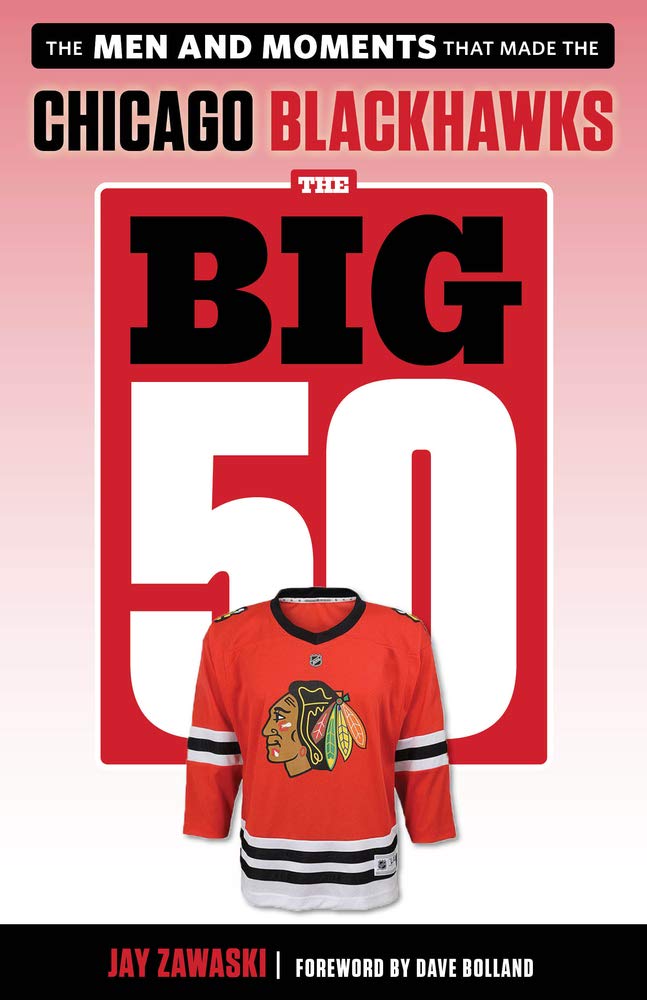
The Big 50: Chicago Blackhawks cover

The Big 50: Chicago Blackhawks (The Men and Moments that Made the Chicago Blackhawks)

Relive the greatest players, personalities, and turning points in Blackhawks history in this countdown of the 50 most influential figures and moments that shaped the franchise.

Buy on Amazon
The PDF versions of some of our hockey books are now available for free download: Take a look!

Tuesday, April 14, 2026

Ron Stewart’s Only NHL Hat Trick Comes In A Perfect Night For Toronto

ron stewart toronto maple leafs 1954-55 parkhurst 23 nhl hockey card

Ron Stewart built a long and reliable 21-year career in the National Hockey League, suiting up for over 1,300 regular season games and adding another 119 in the playoffs. While he was certainly capable offensively, finishing with 276 goals and 529 points, he was never known as a prolific goal scorer. That made one night in December of 1954 stand out above the rest.

Quick Facts

  • Ron Stewart recorded the only hat trick of his 21-year NHL career on December 8, 1954
  • He scored all three goals for the Toronto Maple Leafs in a 3-1 win over the Montreal Canadiens
  • Ed Litzenberger scored Montreal’s lone goal—his final goal with the Canadiens before being traded two days later
  • Stewart’s goals came in all three periods, including the game-winner in the second
  • He finished the night with 3 goals on just one of his rare multi-goal performances
  • Stewart went on to play 21 NHL seasons, totaling 276 goals and 529 points
  • He won three consecutive Stanley Cups with Toronto from 1962 to 1964

On December 8, 1954, skating for the Toronto Maple Leafs, Stewart delivered the only hat trick of his NHL career and he did it in dramatic fashion. In front of the home crowd, he scored all three goals in a 3-1 victory over the Montreal Canadiens, accounting for the entirety of Toronto’s offense.

The Canadiens struck first when Ed Litzenberger opened the scoring early, beating Leafs goaltender Harry Lumley for his seventh goal of the season. It would be Montreal’s only goal of the game and, notably, the last Litzenberger would score for the franchise before being traded just two days later.

Stewart took over from there. Late in the first period, he netted his 10th of the season to tie the game, finishing a play set up by Tim Horton and Rudy Migay. He struck again early in the second period, scoring what would stand as the game-winning goal with assists from Jim Morrison and Joe Klukay. Stewart completed the hat trick in the third period, adding an insurance marker with Klukay and Migay once again contributing on the play.

Although it would be his only three-goal game, Stewart’s career was anything but quiet. From 1952-53 through 1972-73, he played for six NHL teams, including the Maple Leafs, Boston Bruins, St. Louis Blues, New York Rangers, Vancouver Canucks, and New York Islanders. His most successful years came in Toronto, where he was part of a dynasty that captured three straight Stanley Cups from 1962 through 1964.

Top Shelf Trivia: The Toronto Maple Leafs cover

Top Shelf Trivia: The Toronto Maple Leafs

Test your knowledge of one of hockey’s most storied franchises with this collection of challenging and fun Toronto Maple Leafs trivia covering players, games, and unforgettable moments.

Buy on Amazon
The PDF versions of some of our hockey books are now available for free download: Take a look!

Monday, April 13, 2026

Steve Payne Brings the Pain: North Stars Shock Bruins in 1981

steve payne minnesota north stars 1980-81 o-pee-chee 274

The Minnesota North Stars and Boston Bruins were evenly matched on paper during the 1980-81 NHL season, each finishing with 87 points. But when the playoffs began, that balance quickly disappeared. In their best-of-five opening round series, one player made all the difference: Steve Payne.

Game 1 at Boston Garden on April 8 set the tone. Payne erupted for a hat trick, scoring three of Minnesota’s five goals. His biggest moment came just 3:34 into overtime, when he beat Rogie Vachon to seal the win. Payne had already opened the scoring and tied the game early in the third, delivering a complete performance right out of the gate.

Less than 24 hours later, Payne struck again. In Game 2, he piled up four points with two goals and two assists in a wild 9-6 victory. Once again, he solved Vachon twice before the Bruins turned to Marco Baron in relief. Dino Ciccarelli matched Payne with four points of his own, but it was Payne’s relentless pressure that kept Boston on its heels throughout.

Game 3 back in Minnesota brought even more chaos. The North Stars jumped out to a 4-0 lead, with Payne contributing two goals and an assist in the 6-3 win. The game featured four shorthanded goals, three by Boston and one by Minnesota, but the outcome was never truly in doubt. Payne’s late first-period goal stood as the game-winner, putting the finishing touch on a dominant series.

In just three games, Payne racked up seven goals and three assists for ten points, including two game-winning goals. He stayed hot into the next round, scoring twice in Game 1 against Buffalo. Minnesota rode that momentum all the way to the Stanley Cup Final before falling to the New York Islanders in five games. By the end of the playoffs, Payne had compiled an incredible 29 points in 19 games, cementing his place as one of the most impactful performers of the 1981 postseason.

Mirage of Destiny: The Story of the 1990-91 Minnesota North Stars cover

Mirage of Destiny: The Story of the 1990-91 Minnesota North Stars

A deep dive into the remarkable season of the Minnesota North Stars — their playoff run, key moments, and legacy.

Buy on Amazon
The PDF versions of some of our hockey books are now available for free download: Take a look!