Showing posts with label Phil Myre. Show all posts

Thursday, October 8, 2026

Rogie Vachon Records His 50th NHL Shutout Against the Surging Flyers

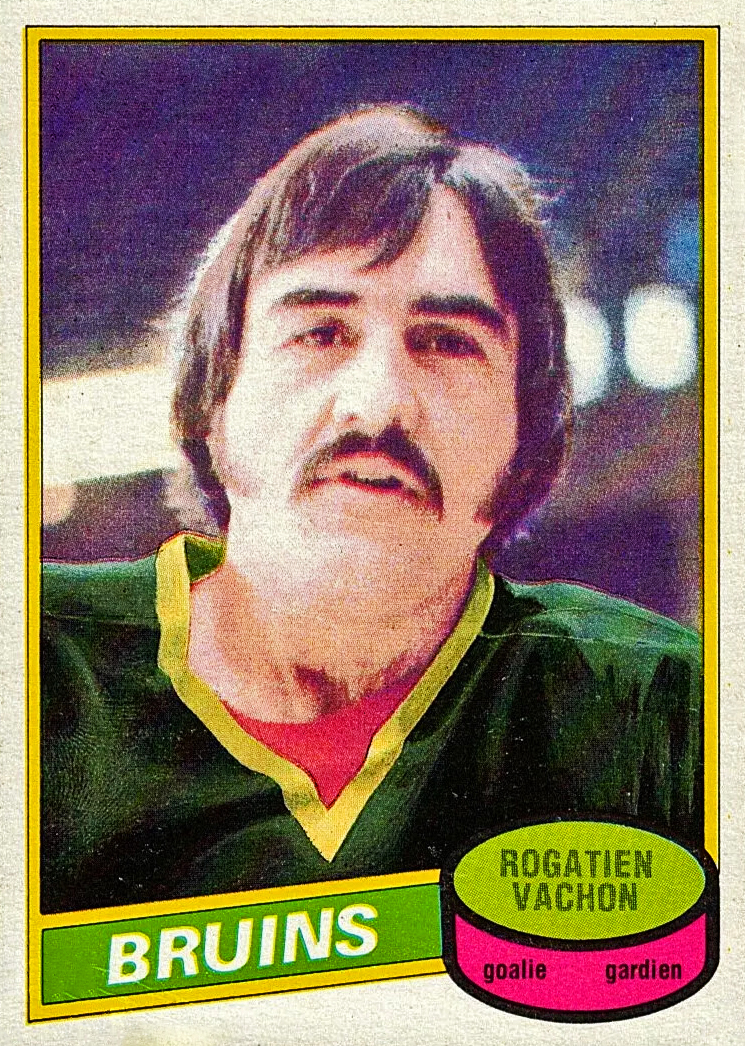
Image of the 1980-81 O-Pee-Chee 110 NHL hockey card featuring Rogie Vachon of the Boston Bruins.

The Philadelphia Flyers arrived at Boston Garden on November 16, 1980, riding a 13-game unbeaten streak. The Boston Bruins, meanwhile, had managed just four wins through their first 16 games. It hardly looked like the ideal matchup for a Boston breakthrough, but Rogie Vachon helped deliver one. Making his 10th appearance as a Bruin, the veteran goaltender stopped all 19 shots he faced to record his 50th career NHL shutout in a 1-0 victory.


Highlights

  • Vachon recorded his 50th NHL shutout on November 16, 1980.

  • Boston defeated Philadelphia 1-0 at Boston Garden.

  • The loss ended the Flyers’ 13-game unbeaten streak.

  • Brad Park scored the only goal at 9:35 of the second period.

  • Vachon made 19 saves; Phil Myre stopped 29 of 30 shots.

  • Vachon’s first NHL shutout came with Montreal on March 5, 1967.

  • He retired with 51 regular-season shutouts and entered the Hockey Hall of Fame in 2016.


More than 13 years had passed since Vachon’s first NHL shutout. On March 5, 1967, in just his eighth NHL appearance, he made 29 saves as the Montreal Canadiens defeated the New York Rangers 2-0. By the time he reached number 50, his career had taken him from Montreal to the Los Angeles Kings and Detroit Red Wings before bringing him to Boston.

Neither team scored through the opening period or the first half of the second. Finally, at 9:35 of the middle frame, Brad Park beat Philadelphia goaltender Phil Myre with a slapshot from the blue line. Stan Jonathan and Peter McNab earned the assists on what proved to be the game’s only goal.

Myre gave the Flyers every chance to extend their unbeaten streak, turning aside 29 of Boston’s 30 shots. At the other end, Vachon handled a lighter workload without allowing a breakthrough. Tom Gorence was Philadelphia’s busiest shooter, accounting for five of the Flyers’ 19 shots on net.

The milestone performance was Vachon’s only shutout in 53 appearances during the 1980-81 season. He added one more in 1981-82, his final NHL campaign, to finish with 51 regular-season shutouts, the same career total as Dave Kerr, Tomas Vokoun and Curtis Joseph. In 2016, Vachon’s long wait for another milestone ended when he was inducted into the Hockey Hall of Fame.
NHL Playoff Hat Tricks Of The 1960s cover

NHL Playoff Hat Tricks Of The 1960s

Relive the NHL playoff hat tricks of the 1960s with the stories, stars, and memorable performances behind some of the decade’s biggest postseason scoring nights.

Buy on Amazon
The PDF versions of some of our hockey books are now available for free download: Take a look!

Monday, December 1, 2025

Expansion Showdown: Inside the Islanders and Flames First NHL Game

The 1972-73 NHL season opened with something truly rare: two brand-new franchises beginning their journey against each other. On October 7, 1972, the New York Islanders and Atlanta Flames met at Nassau County Coliseum, marking the first official NHL game in the history of both clubs. And with two fresh teams on the ice, the night gave fans a flood of “firsts” that would forever be etched into the record books.

Atlanta struck first when Morris Stefaniw made Flames history, and NHL trivia history, with the first goal in franchise history, a shorthanded marker at 12:48 of the first period. Assisted by Lew Morrison, the goal came with Randy Manery in the box for hooking. Amazingly, that one moment was also the only NHL goal Stefaniw ever scored, as his career lasted just 13 games that season.

The Islanders’ turn came late in the second period. Veteran Ed Westfall buried the first goal in Islanders history, and fittingly, it came on the power play. With Larry Romanchych off for hooking, Westfall capitalized on a setup from Germain Gagnon and Dave Hudson, beating Phil Myre at 19:29 to give New York its first ever tally.

The Flames took control in the third when Bob Leiter scored the first game-winning goal in franchise history, making it 3-1 at the 3:17 mark. The Flames would hold on for a 3-2 victory, giving Phil Myre the first win ever recorded by an Atlanta goaltender. The game also saw the first penalties for each franchise, Randy Manery for Atlanta and Ken Murray for New York, adding to the long list of “day one” milestones.

The PDF versions of some of our hockey books are now available for free download: Take a look!

Islanders vs. Flames: Comparing the 1972-73 Inaugural NHL Seasons

When the NHL expanded for the 1972-73 season, two brand-new franchises took the ice for the first time: the New York Islanders and the Atlanta Flames. Both clubs launched their journeys on the same night, October 7, 1972, but their inaugural seasons unfolded in dramatically different ways. While the Islanders endured growing pains, the Flames delivered one of the more competitive expansion debuts of their era. Here’s a detailed look at how both teams fared in their first year.

The Islanders struggled out of the gate, finishing last overall with a 12-60-6 record. Their -177 goal differential remains one of the roughest inaugural campaigns in league history. The Flames, meanwhile, surprised much of the hockey world by playing disciplined, structured hockey that earned them 65 points and a mid-pack finish in the West Division. Though neither team qualified for the postseason, Atlanta quickly showed it could compete with established clubs.

Offensively, both teams lacked star power, but the Flames generated more balanced production. The Islanders leaned heavily on Ralph Stewart and Billy Harris for scoring, while Atlanta spread its offense across players like Rey Comeau, Bob Leiter, and Bobby Stewart. Defensively, the contrast was even sharper: the Flames allowed 102 fewer goals than the Islanders, thanks in part to steadier goaltending.

Between the pipes, the Islanders split duties between future Hall of Famer Billy Smith and Gerry Desjardins. Smith showed flashes of what he would become, but the team in front of him struggled badly. In Atlanta, Phil Myre and Dan Bouchard formed a reliable tandem that kept the Flames competitive most nights.

Coaching and management also played major roles. The Islanders changed coaches early in the season and relied heavily on long-term planning from GM Bill Torrey, a strategy that eventually paid off with multiple Stanley Cups. The Flames, guided by coach Boom Boom Geoffrion and GM Cliff Fletcher, took a more immediate competitive approach, emphasizing structure over raw skill.

Ultimately, the debut seasons of these two expansion teams helped shape their long-term identities. The Islanders’ early struggles positioned them for franchise-defining draft picks and a dynasty that dominated the early 1980s. The Flames set a foundation for competitive hockey that would later flourish after the franchise moved to Calgary.

NHL Hockey Trivia: 1972-73 Expansion

Much more NHL hockey trivia can be found at our website: World's Best Hockey Trivia

1. Which team finished with more points in the 1972-73 season?


2. Which Islanders player led the team in scoring during their inaugural season?


3. Who was the Flames’ head coach during their first NHL season?


4. Which goaltending duo backstopped the Flames during the 1972-73 season?


5. Which team allowed significantly fewer goals during their inaugural season?


Monday, October 27, 2025

When Phil Myre and Dan Bouchard Faced Off As Rivals For The First Time

In the early years of the Atlanta Flames, Phil Myre and Dan Bouchard shared goaltending duties and helped build the foundation for the franchise starting in the 1972-73 NHL season. The tandem was split up when, on December 12, 1977, Myre, along with Curt Bennett and Barrie Gibbs, was traded to the St. Louis Blues for Yves Bélanger, Bob MacMillan, and Dick Redmond.

Just over two weeks later, fate brought the two former teammates face-to-face. On December 29, 1977, the Blues visited the Omni in Atlanta for the first meeting between the two teams since the deal. Both Myre and Bouchard got the start, but the night quickly took a twist. After Claude Larose scored to give St. Louis a 3-2 lead early in the second period, Bouchard was pulled and replaced by Yves Bélanger, who had been part of the same trade.

From that point on, it became a showdown between the two goalies traded for each other. Bouchard had allowed three goals on twelve shots, while Bélanger stood tall in relief, stopping 16 of 17 shots. Myre, facing 34 shots from his old teammates, allowed five goals as Atlanta emerged with a 5-4 victory. Curt Bennett added two assists against his former club, while Bob MacMillan picked up one point for his new team.

When the two teams met again on March 15, 1978, this time in St. Louis, the goaltending story flipped. Bélanger, once again in net for Atlanta, was brilliant with 35 saves and even an assist on Bob MacMillan’s opening goal in a 6-2 Flames win. Myre struggled in the opposite crease, allowing six goals on 27 shots.
The PDF versions of some of our hockey books are now available for free download: Take a look!

NHL Hockey Trivia: Phil Myre & Dan Bouchard

Much more NHL hockey trivia can be found at our website: World's Best Hockey Trivia

1. In what season did Phil Myre and Dan Bouchard first share goaltending duties for the Atlanta Flames?


2. Phil Myre and Dan Bouchard helped the Flames record their first-ever playoff appearance in which NHL season?


3. Which goaltender recorded more wins for the Atlanta Flames overall before the team relocated to Calgary?


4. What was notable about the goaltending rotation between Myre and Bouchard during their time in Atlanta?


5. Before joining the Flames, which organization originally drafted Dan Bouchard?


Tuesday, September 23, 2025

Bill Clement Leads Atlanta Flames Past Rangers on New Year’s Eve 1976

On December 31, 1976, the Atlanta Flames rang in the New Year in style at Madison Square Garden with a 4-2 win over the New York Rangers.

The night belonged to Bill Clement, who had a hand in three of the four Flames goals. After a scoreless first period, the Rangers opened the scoring early in the second when Wayne Dillon beat Phil Myre just 59 seconds in. But Clement responded midway through the frame, scoring a shorthanded goal while Bobby Simpson was in the penalty box.

The Rangers regained the lead early in the third on a Mike McEwen marker, but the Flames stormed back with three unanswered goals. Bobby Simpson, Tom Lysiak, and Ken Houston all found the back of the net, with Clement assisting on the Simpson and Houston tallies. Tim Ecclestone added three assists of his own to match Clement’s three-point performance.

The Flames fired 45 shots on Gilles Gratton, with Guy Chouinard leading the way with eight and Lysiak adding seven. On the Rangers’ side, Phil Esposito had a frustrating night with seven shots, no points, and a -2 rating. In the final seconds, tempers flared as Esposito and Pat Quinn nearly tangled, resulting in roughing penalties.

About Bill Clement

Bill Clement played 719 regular season and 50 playoff games in the National Hockey League between 1971-72 and 1981-82 with the Philadelphia Flyers, Washington Capitals, Atlanta Flames and Calgary Flames. He was a two-time Stanley Cup champion with the Flyers.

Clement was a second round pick by the Flyers at the 1970 NHL Amateur Draft after three years of junior with the Ottawa 67's. Despite being a defensive forward, Bill stands as eighth overall in total points with the Atlanta Flames.

The PDF versions of some of our hockey books are now available for free download: Take a look!

NHL Hockey Trivia: Bill Clement

Much more NHL hockey trivia can be found at our website: World's Best Hockey Trivia

1. Bill Clement was originally drafted by which NHL team?


2. Clement won two Stanley Cups early in his career. In which seasons did he capture them with the Flyers?


3. Bill Clement was part of a major trade that sent him from the Flyers to the Washington Capitals in 1975. Which future Hall of Famer went the other way?


4. Clement enjoyed his most productive offensive seasons with which team?


5. After retiring from the NHL, Clement became well known as: