Showing posts with label red berenson. Show all posts

Tuesday, August 25, 2026

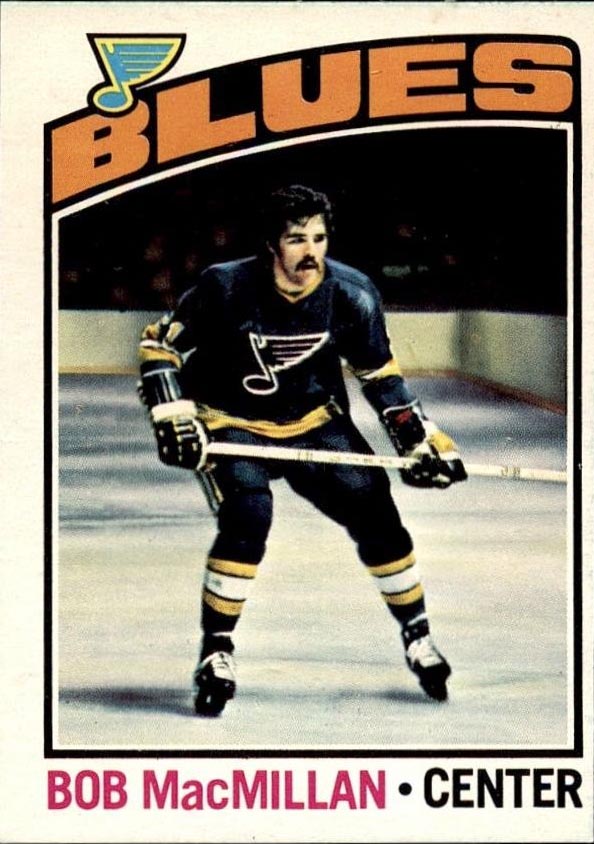
Bob MacMillan's Shorthanded Goal Sinks The Sabres In 1976

Image of the 1976-77 O-Pee-Chee 38 NHL hockey card featuring Bob MacMillan of the St. Louis Blues.

Bob MacMillan was beginning to establish himself as an NHL regular with the St. Louis Blues during the 1975-76 season. Originally a first-round pick of the New York Rangers in the 1972 NHL Amateur Draft, the Charlottetown, Prince Edward Island native spent two seasons in the WHA before splitting 1974-75 between the Rangers and the AHL's Providence Reds. A move to St. Louis gave MacMillan a fresh start, and on January 13, 1976, he played a major role in a convincing victory over the Buffalo Sabres.


Highlights

  • January 13, 1976: St. Louis defeated Buffalo 7-3

  • Bob MacMillan recorded 2 goals and 1 assist

  • His first goal was unassisted and shorthanded

  • The shorthanded goal ultimately stood as the game-winner

  • MacMillan and Garry Unger each finished with three points

  • MacMillan put seven shots on Buffalo goalie Gary Bromley

  • Yves Belanger stopped 31 of 34 shots

  • MacMillan later won the 1978-79 Lady Byng Trophy


Buffalo opened the scoring when Brian Spencer scored the first of his two goals on the night. The Blues quickly answered, with MacMillan and Red Berenson setting up Garry Unger at 9:46 of the opening period. From there, St. Louis took control and Buffalo would not regain the lead.

MacMillan produced one of the game's biggest moments early in the second period. With Bert Wilson serving a penalty, MacMillan scored an unassisted shorthanded goal on Buffalo goaltender Gary Bromley at 1:46. The goal gave St. Louis a 4-1 advantage and ultimately stood as the game-winner in a 7-3 Blues victory.

MacMillan wasn't finished. At 11:54 of the second period, he scored his second goal of the game, this time with assists going to Jerry Butler and Unger. MacMillan finished the night with two goals, one assist and seven shots on goal. Unger also recorded two goals and an assist, while Blues goaltender Yves Belanger stopped 31 of Buffalo's 34 shots.

MacMillan went on to enjoy a lengthy NHL career from 1974-75 through 1984-85, appearing in 753 regular-season games and another 31 in the playoffs. He played for the Rangers, Blues, Atlanta and Calgary Flames, Colorado Rockies, New Jersey Devils and Chicago Blackhawks. A six-time 20-goal scorer, MacMillan reached a career-high 38 goals in 1977-78 and won the Lady Byng Trophy the following season.
Bob Plager's Tales from the Blues Bench cover

Bob Plager's Tales from the Blues Bench

Insights, stories, and unforgettable moments from Bob Plager’s time with the St. Louis Blues — a must-read for Blues fans.

Buy on Amazon
The PDF versions of some of our hockey books are now available for free download: Take a look!

Thursday, August 6, 2026

One Year After His 6 Goal Game, Red Berenson Lit Up The Flyers Again

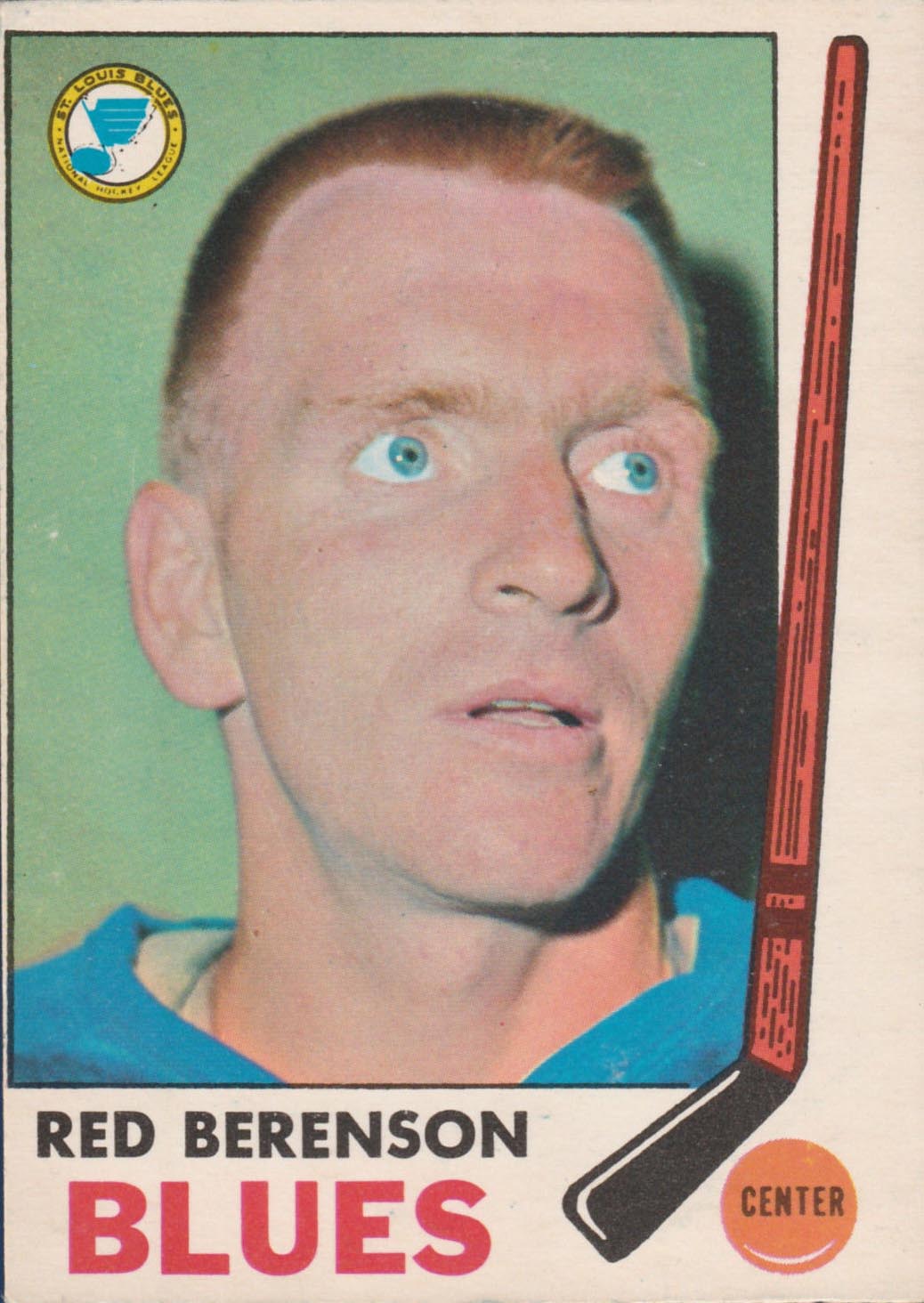
1969-70 O-Pee-Chee 20 NHL hockey card featuring Red Berenson of the St. Louis Blues.

When hockey fans think of Red Berenson and the Philadelphia Flyers, one game immediately comes to mind: his unforgettable six-goal performance during the 1968-69 season. While that historic night remains one of the greatest individual performances in NHL history, Berenson wasn't finished tormenting Philadelphia.


Highlights:

  • Red Berenson records a hat trick in an 8-0 win over Philadelphia.

  • Scored the first goal in all three periods.

  • Added an assist for a four-point night.

  • Frank St. Marseille contributed five points (2G, 3A).

  • Jacques Plante posted a 23-save shutout.

  • Berenson finished with 12 points in seven games against the Flyers that season.

  • Also assisted on all four Blues goals in a March 1970 victory over Philadelphia


Less than a year later, on November 1, 1969, the St. Louis Blues star delivered another memorable performance against the Flyers. This time it was "only" a hat trick, but it helped power the Blues to a commanding 8-0 victory at St. Louis Arena. Berenson opened the scoring in every period, netting his third, fourth and fifth goals of the young 1969-70 campaign.

The first two goals came on the power play against Bernie Parent. Bobby Clarke was serving a tripping penalty when Berenson converted the game's opening goal, with assists from Frank St. Marseille and Larry Keenan. Later, after Earl Heiskala picked up an extra minor for elbowing following a fight with Ray Fortin, Berenson struck again with the man advantage. His third goal came just 29 seconds into the final period, beating Doug Favell after Parent had been replaced to start the third.

Berenson wasn't done there. He also picked up a first-period assist on one of Larry Keenan's goals to finish with four points. Frank St. Marseille enjoyed an even bigger offensive explosion, recording two goals and three assists for a five-point evening. In goal, veteran Jacques Plante turned aside all 23 Philadelphia shots to earn the shutout as the Blues completely dominated from start to finish.

Philadelphia simply couldn't find an answer for Berenson during the 1969-70 season. In seven games against the Flyers, he totaled five goals and seven assists for 12 points. His most remarkable playmaking performance came on March 12, 1970, when he assisted on all four St. Louis goals in a 4-2 victory. Although he didn't score that night, Berenson still led both teams with six shots on Bernie Parent, once again proving that few players enjoyed facing the Flyers more than Red Berenson during that era.

The Franchise: St. Louis Blues (A Curated History of the Blues) cover

The Franchise: St. Louis Blues (A Curated History of the Blues)

A curated history celebrating the St. Louis Blues — their iconic players, historic moments, and lasting impact on hockey culture.

Buy on Amazon
The PDF versions of some of our hockey books are now available for free download: Take a look!

Thursday, October 9, 2025

Len Fontaine Bursts Onto The Scene With 3 Points In His 1st NHL Game

On opening night of the 1972-73 NHL season, rookie forward Len Fontaine made a stunning first impression in his very first game with the Detroit Red Wings. Facing the New York Rangers at the Olympia, Fontaine needed less than eight minutes to score his first NHL goal, a power play marker on legendary goalie Ed Giacomin, assisted by Red Berenson and Ron Stackhouse.

Before the first period was over, Detroit held a 4-0 lead, and Fontaine had already picked up two assists, one on Guy Charron’s goal and another on Berenson’s. His debut performance was nothing short of spectacular: three points in his first NHL game.

Detroit followed up with another home win, 4-3 over the Boston Bruins, where Fontaine repeated his performance with another three-point game, setting up two goals by Charron and one by Berenson.

After just two games, fans were beginning to wonder if Detroit had found their next superstar. But as it turned out, those early fireworks would represent the peak of Fontaine’s NHL scoring. His six points in two games, plus a goal against Philadelphia in Game 3, would make up nearly 40% of his total NHL production.

Fontaine went on to play 39 games in 1972-73 and seven more in 1973-74, for a total of 46 NHL games. He then carved out a long and successful career in the International Hockey League (IHL), highlighted by a championship win with the Toledo Goaldiggers in 1977-78.
The PDF versions of some of our hockey books are now available for free download: Take a look!

NHL Hockey Trivia: Len Fontaine

Much more NHL hockey trivia can be found at our website: World's Best Hockey Trivia

1. Len Fontaine made his NHL debut with the Detroit Red Wings during which season?


2. Before turning pro, Fontaine starred in junior hockey with which Ontario team?


3. Len Fontaine won an International Hockey League (IHL) championship in 1977-78 with which team?


4. In his first two NHL games, Fontaine collected how many total points?


5. After leaving the NHL, Fontaine became a consistent scorer in the minors. Which of these leagues did he *not* play in?


Monday, July 21, 2025

In Season Two The St. Louis Blues Finally Get Their First NHL Hat Trick


The St. Louis Blues made their NHL debut in the 1967-68 season, but offensive fireworks were in short supply. Red Berenson led the expansion team in scoring that year, notching 22 goals and 51 points. No other Blues player managed more than 15 goals.

Things began to shift in the team’s second season. Berenson upped his production, and the addition of veteran sniper Camille “The Eel” Henry added a new scoring threat. On November 3, 1968, at Detroit Olympia, Henry made franchise history by scoring the first hat trick in Blues history in a game against the Red Wings.

Detroit jumped out to a 2-0 lead with goals from Frank Mahovlich and Gary Bergman. Henry got the Blues on the board late in the first period with a powerplay goal at 16:39. By the end of the second, it was 4-2 Red Wings but Henry wasn’t finished.

In the third period, Henry lit the lamp twice in a 15-second span to tie the game. Two of his three goals came on the powerplay, and Red Berenson assisted on two of them. All four St. Louis goals were scored against Red Wings goalie Roger Crozier, and the game ended in a 4-4 tie.

Just four nights later, on November 7, Berenson delivered one of the most iconic single-game performances in NHL history, scoring six goals in an 8-0 road win over the Philadelphia Flyers. Henry added to the onslaught with a goal and two assists, while Berenson recorded seven points in total. Doug Favell was in net for the shell-shocked Flyers.

About Camille Henry

Camille Henry played 727 regular season and 47 playoff games in the National Hockey League between 1953-54 and 1969-70 with the New York Rangers, Chicago Blackhawks and St. Louis Blues. He was the Calder Trophy winner in 1953-54 as NHL rookie of the year and won the Lady Byng Trophy in 1957-58.

Never a Stanley Cup champion, Henry did win a Calder Cup title in the AHL with the Providence Reds in 1955-56. That year, he led the league with exactly 50 goals and added ten more in the post season. His career best in the NHL was 37 goals in 1962-63 with the Rangers. That total placed him second, just a single goal behind leader Gordie Howe.


Friday, November 29, 2024

Red Berenson's Final Year In The NHL


Both O-Pee-Chee and Topps thought Red Berenson was good for another year in the NHL, featuring him on hockey cards in their 1978-79 sets. However, Red decided to call it a career as a player and his final action came during the 1977-78 season with the St. Louis Blues.

Captain Berenson played all 80 games for the Blues in his final campaign at 39 years old. He put up respectable numbers with 13 goal and 25 assists for 38 points. Three of those thirteen came in a February 28, 1978 game against the Minnesota North Stars at the Checkerdome. It was the last of his six NHL hat tricks, the final two coming against the Stars.

Red didn't get on the board until 15:14 of the second period, scoring on Minnesota goalie Paul Harrison with assists going to Bob Hess and goalie Phil Myre. This put the Blues up 4-1 in the game. Just 47 seconds into the third period, Berenson had his second of the night, assisted by Bill Fairbairn. The hat trick goal was scored at 10:09 of the third period, unassisted. That goal was the last of the game in a 7-1 win for the home team.

Over the season, Red also had seven two point games to go with the hat trick. He had two game winning goals, both against the Los Angeles Kings. Both those goals were scored on L.A. goalie Rogie Vachon. In a 3-2 win over the Kings at the Great Western Forum, Berenson broke a 2-2 tie with just 39 seconds left in the match.

Between 1961-62 and 1977-78, Red Berenson played 987 regular season and 85 playoff games in the National Hockey League with the Montreal Canadiens, New York Rangers, Detroit Red Wings and St. Louis Blues. He won a Stanley Cup championship with the Habs in 1964-65.


Wednesday, February 11, 2015

4 St. Louis Blues Jack Adams Award Winners


red berenson st. louis blues 1977-78 o-pee-chee hockey card
The St. Louis Blues of the National Hockey League have yet to take home their first Stanley Cup. The team joined the league in the expansion boom of 1967-68. The team has produced some great regular season teams and three coaches that won the Jack Adams Award as the NHL’s coach of the year.

Red Berenson 1980-81


Red Berenson was no stranger to St. Louis when he became head coach of the team in 1979-80. The Blues were one of four teams that Berenson played for during his nearly 1,000 game NHL career, which also saw him play for the Montreal Canadiens, New York Rangers and Detroit Red Wings. Red coached the Blues for just three years and won the Jack Adams Award in 1980-81. He has been the head coach of the University of Michigan Wolverines since the 1984-85 season.

That season, the Blues finished with 107 points, 27 more than the previous year. The team finished first in the Smythe Division and powered past the Pittsburgh Penguins in the opening round of the Stanley Cup playoffs before falling to the New York Rangers. The team was led by Bernie Federko, Wayne Babych, Brian Sutter and Mike Liut.

Brian Sutter 1990-91


Brian Sutter moved behind the bench when his playing career ended and became the next St. Louis coach to win the Jack Adams Award in 1990-91. With the help of Brett Hull, Adam Oates and Scott Stevens, the Blues finished with 105 points, a 22 points improvement over the previous year, good for second place in the Norris Division and second overall. St. Louis beat the Detroit Red Wings in the first round of the playoffs but lost to the Minnesota North Stars in the second.

Sutter played his entire career in a Blues jersey, from 1976-77 to 1987-88. He coached in the National Hockey League from 1988-89 to 2003-04. After St. Louis, he coached the Boston Bruins, Calgary Flames and Chicago Blackhawks.

Joel Quenneville 1999-00


Joel Quenneville is the last St. Louis Blues head coach to win the Jack Adams Award. Quenneville won the award in 1999-00 as the Blues posted 114 points to finish first overall in the NHL. It was a 27 point improvement on the previous year. The Stanley Cup playoffs were unkind with St. Louis losing in the first round to the San Jose Sharks. Playing starring roles on the 1999-00 Blues were Pavol Demitra, Chris Pronger and Al MacInnis.

Joel played over 800 games in the NHL from 1978-79 to 1990-91 with the Toronto Maple Leafs, Colorado Rockies, New Jersey Devils, Hartford Whalers and Washington Capitals. He has been a head coach in the National Hockey League since 1996-97. He began with the Blues and after a stint with the Colorado Avalanche, settled in with the Chicago Blackhawks. He was behind the bench for Chicago’s Stanley Cup victories in 2009-10 and 2012-13.
 

Ken Hitchcock 2011-12

 
Hitchcock took over as head coach of the Blues during the 2011-12 season, replacing Davis Payne 13 games into the campaign. It was his first head coaching job since getting let go by the Columbus Blue Jackets in 2009-10. Ken led St. Louis to a first place tie in the Eastern Conference with the New York Rangers and just to points behind the Vancouver Canucks for first overall in the National Hockey League. The Blues were swept in the second round by eventual Stanley Cup champions, the Los Angeles Kings.
 
Never a player, Hitchcock got his start in coaching with the Kamloops Blazers in the WHL. The Blazers never had a losing season during Ken's six years behind the bench. He started out in the NHL in 1990-91 as an assistant coach with the Philadelphia Flyers, under head coach Paul Holmgren. Since 1995-96, Hitchcock has been a head coach in the NHL with the Dallas Stars, Philadelphia Flyers, Columbus Blue Jackets and the Blues. He won a Stanley Cup championship with the Stars in 1998-99.
 

Thursday, January 2, 2014

Hockey Trivia: NHL Goal Scoring Legend Joe Malone


Often over-looked when it comes to naming the greatest hockey players to ever play the game, Joe Malone is a name ever hockey fan should know. Because he played in the game’s infancy when there was a 24 game schedule, before the days of television broadcasts and in an age of whacky rules that would seem foreign to today’s fans and players, Joe Malone goes relatively unnoticed in the history of the National Hockey League.

The following four questions will test and expand the knowledge of the serious hockey fan and may even shock and amaze.

Q. Joe Malone still holds the NHL record for the highest goals per game average in one season after nearly a century has passed. With which team did Malone accomplish this feat?

A. Joe Malone, as a member of the Montreal Canadiens during the 1917-18 season, scored 44 goals in 20 games for an average of 2.2 goals per game. To put this into perspective, in today’s 82 game NHL schedule, that would equate to a 180 goal season. That was the first season of the NHL after the league transformed from the National Hockey Association. Therefore, Malone was the first ever scoring leader.

The 44 goals scored by Joe would remain a single season National Hockey League record until 1944-45. Maurice ‘Rocket’ Richard scored 50 goals that year, but it took him 50 games to do it.

Q. In 1920, Malone set the record for most goals in a NHL game with seven, a record that still stands today. What team did he score his seven goals against?

A. On January 31, 1920, Joe Malone scored seven goals for the Quebec Bulldogs against the Toronto St. Patricks (predecessor to the Toronto Maple Leafs) in a 10-6 win. He also had a six goal game the same year.

To date, just six other players have scored six goals in a single game. Newsy Lalonde accomplished the feat in that 1919-20 season. Corb Denneny of Toronto St. Pats and Cy Denneny of the Ottawa Senators scored six each in games the following season. Syd Howe of the Detroit Red Wings had six in a game during the 1943-44 season. Red Berenson of the St. Louis Blues had six in a 1968-69 game. The last player to accomplish the feat was Darryl Sittler of the Toronto Maple Leafs, nearly 40 years ago, during the 1975-76 season.

Q. What Ontario, Canada based NHL team did Joe Malone play two seasons for?

A. Not the Toronto Maple Leafs or Ottawa Senators. Joe Malone played two years for the Hamilton Tigers, 1920-21 and 1921-22. The Tigers were the result of the Quebec Bulldogs relocating. Malone moved on to the Montreal Canadiens for 1922-23 but his magic was lost. Joe scored just one goal while playing just 29 games over the next two years, his last in the NHL.

The Tigers lasted until the end of the 1924-25 season. For the most part, the Hamilton franchise became the New York Americans for 1925-26. A hard luck story, the Tigers did not qualify for the post season in the first four of their five years of existence. In 1924-25, the team finished first overall in the six team NHL. However, the Hamilton players went on strike and the NHL suspended the team before they could play a single game in the Stanley Cup playoffs.

Q. In what year was Joe Malone inducted into the Hockey Hall of Fame?

A. Malone entered the Hall in 1950, five years after its creation and over 25 years after his playing career came to an end. Joe was part of a group of eight inducted that year. Included among the other seven was Malone’s teammate with the Canadiens in the first two years of the NHL, Newsy Lalonde.